
Last updated: November 2026
Quick answer: Sourcing flexible endoscope components is a bill-of-materials problem, not a generic “parts” request. The critical items—bending section, insertion tube, operation section, light guide, distal tip and working channels—use different materials, processes and tests. A shop that can machine or rivet bending links is not automatically qualified to build a graded-stiffness insertion tube or align a distal imaging module. This guide is for OEM, R&D and procurement teams who need to specify those components and qualify suppliers against evidence, not slogans. Endowista is a flexible endoscope OEM and CDMO partner focused on reusable scopes and components; it does not manufacture complete single-use endoscopes.
If you already know which reusable components or finished assemblies you need, you can request a quote while you work through the checklist below. For how component capability fits a broader manufacturing partnership, see How to Choose a Flexible Endoscope CDMO in 2026.
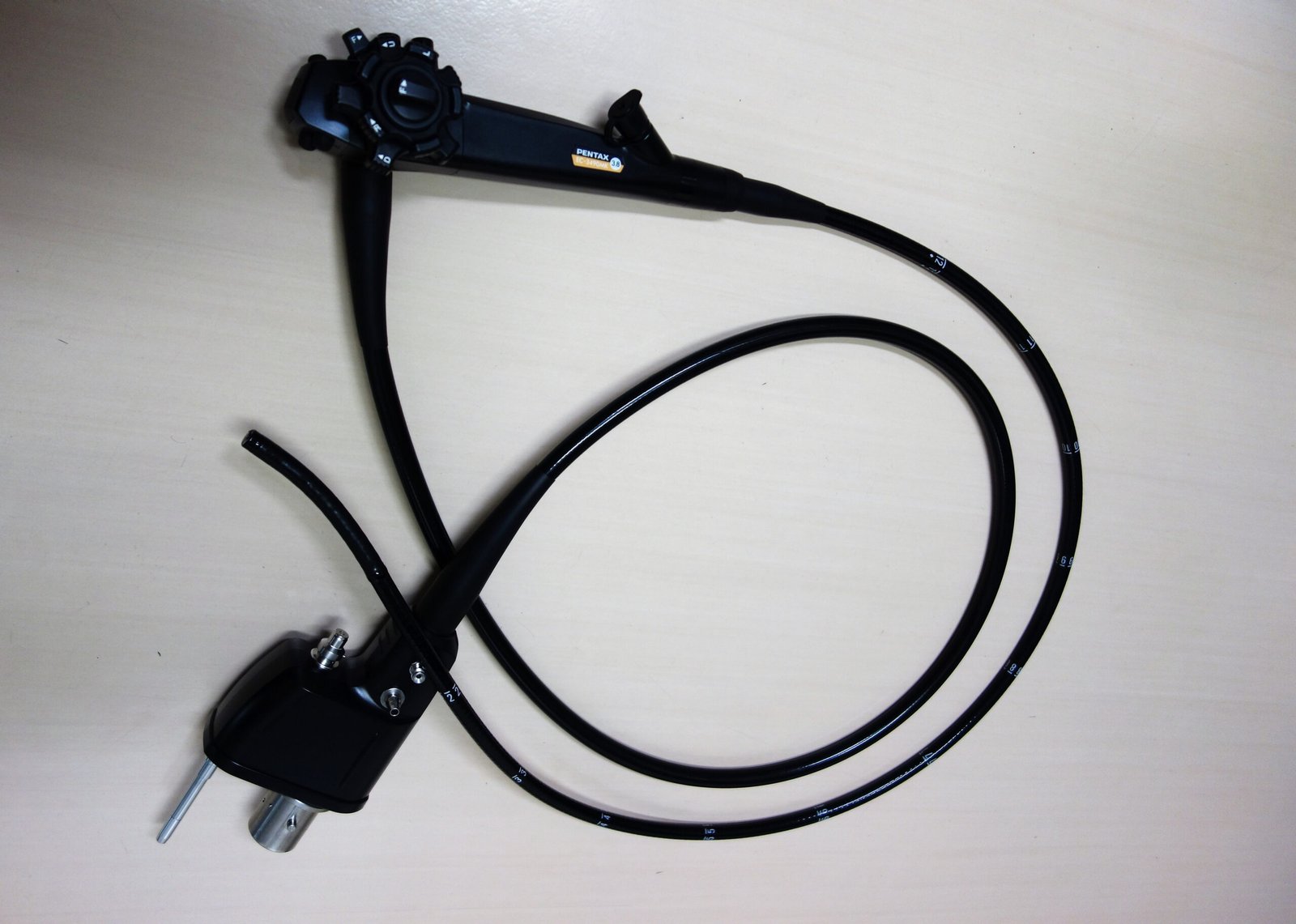
Anatomy of a Flexible Endoscope
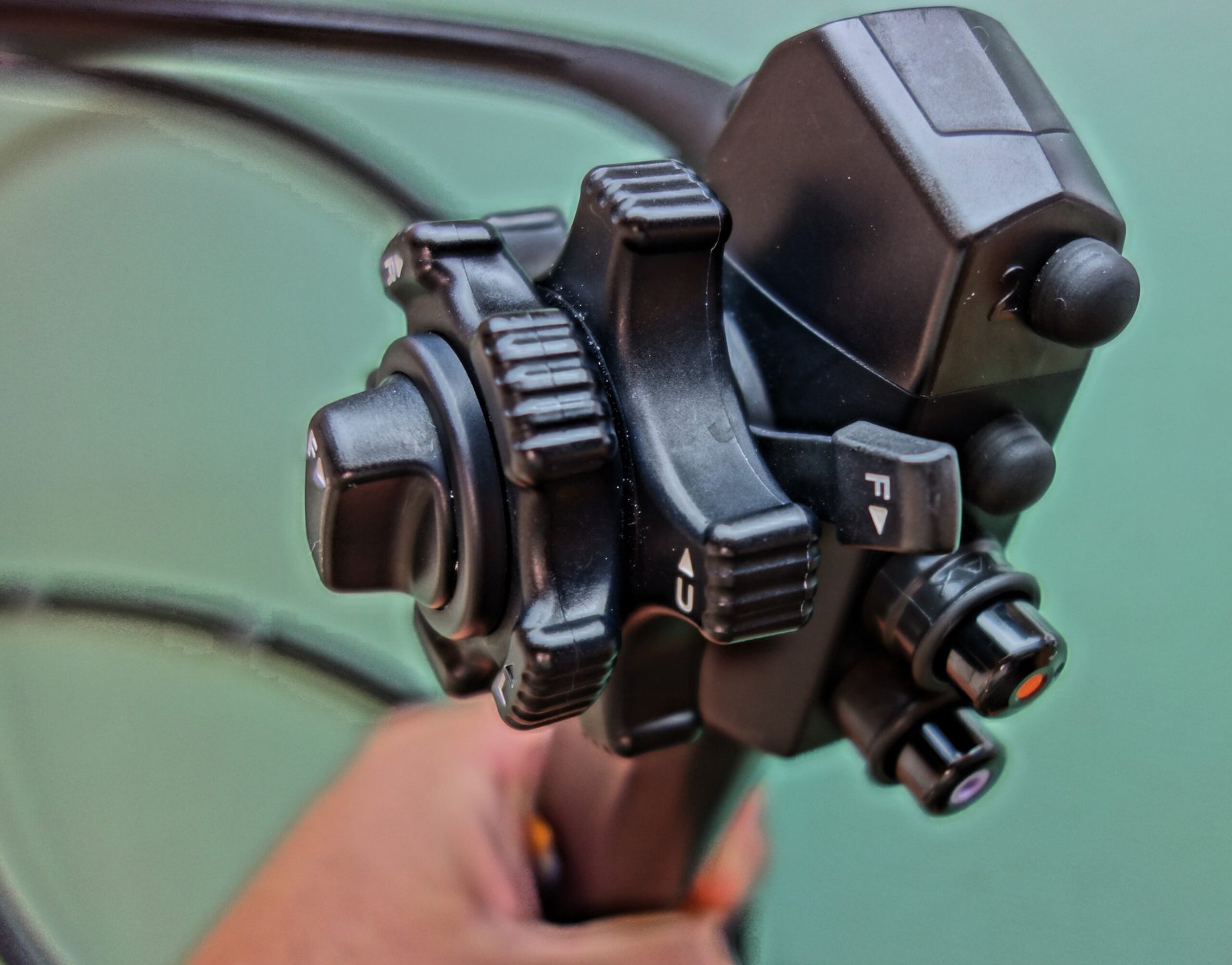
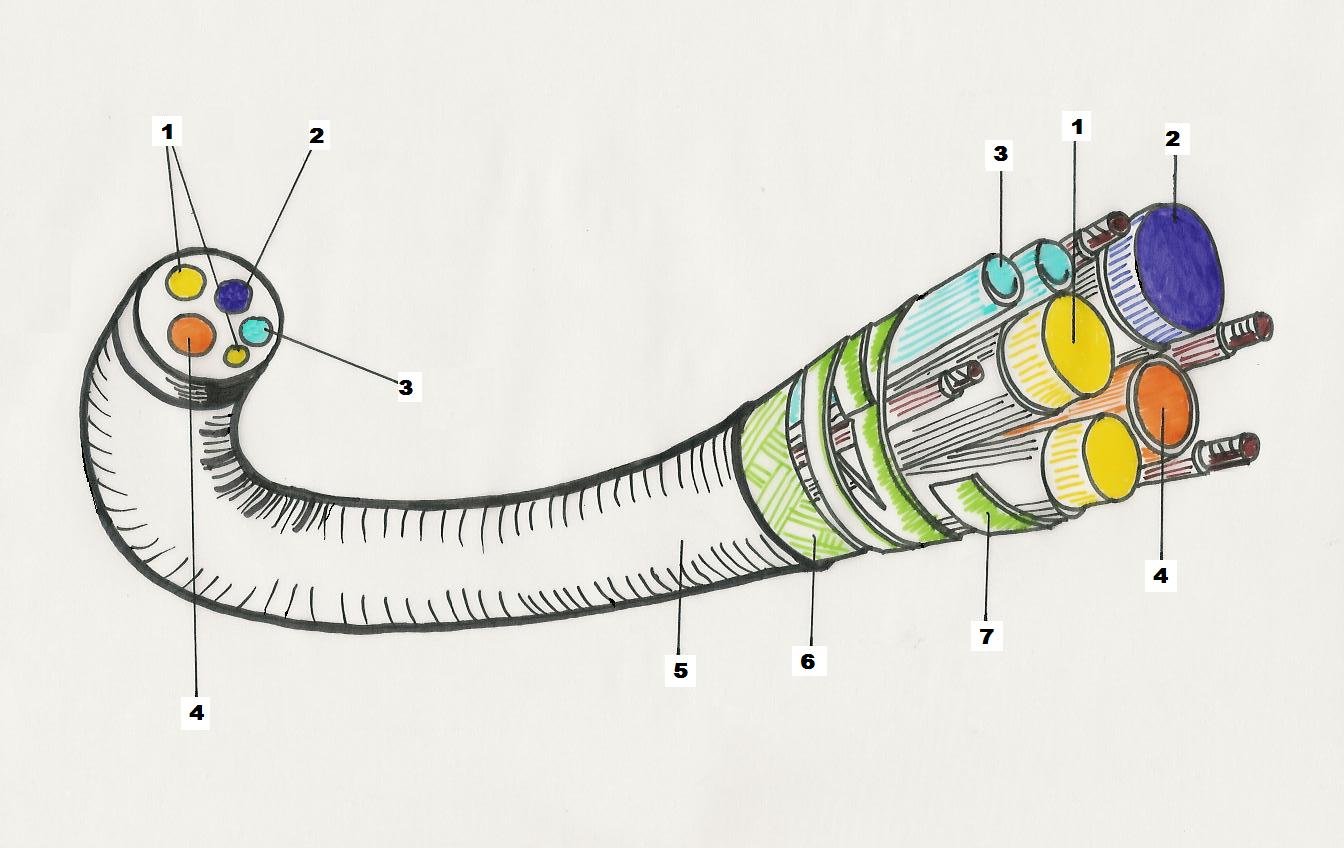
A typical reusable video endoscope is a system of specialized components assembled into one insertion portion and one control portion. An Olympus patent application published in 2009 describes that architecture in plain terms: an elongate insertion portion with a distal rigid tip, a bending portion that can be actuated, and a long flexible insertion tube, with an operation portion connected at the proximal end and a bending-operation knob used to steer the tip.
The same application, and a 2024 Scientific Reports paper on bending-section design, help identify the components OEM teams most often source or specify:
| Component | Role in the finished scope | What public sources describe |
|---|---|---|
| Operation (control) section | Held by the physician; houses angulation knobs and locks, valves, and the instrument-channel inlet | Connected to the proximal end of the insertion portion; a bending-operation knob actuates the bending portion |
| Insertion tube | Flexible shaft between the control section and the bending section | Commonly built as a composite of a coil, a braid and an outer polymeric sheath; stiffness may be varied along the length |
| Bending section | Distal articulating segment that aims the tip | Conventionally, cylindrical links connected so they can rotate relative to each other, covered with a braid or mesh and an outer tube or rubber |
| Distal tip | Faces the tissue: imaging, illumination, instrument outlet, air/water nozzle | Complex-shaped tip parts; illumination and image paths terminate here |
| Light guide | Delivers illumination to the tip | Light-guide fiber is one of the key insertion-portion components Olympus historically had to make in-house when no market supplier existed |
| Working channels | Instrument/suction and air/water service | Run through the inside of the bending-section framework together with data and supply lines |
ISO 8600-1:2025, Endoscopes — Medical endoscopes and endotherapy devices — Part 1: General requirements (5th edition, published March 2025), is the current general standard that “gives definitions of terms and requirements for endoscopes and endotherapy devices used in the practice of medicine.” Component drawings and test plans should be checked against the ISO 8600 series; this article does not quote numeric limits from the paid standard text.
Endowista’s endoscope components offering, as listed on the company site, covers insertion tubes, bending sections, light guides and operation sections for reusable flexible endoscopes (gastroscopes, colonoscopes, bronchoscopes and sigmoidoscopes). That is a components and reusable-scope discussion—not a repair-parts catalog.
Bending Sections: Machined Links vs Laser-Cut Tubes
The bending section is usually the most mechanically demanding component in a flexible endoscope. Two construction families appear repeatedly in the public literature. Neither is “better” in the abstract: the right choice depends on outer diameter, required angulation, cycle life, inner lumen, cost and whether the finished device is reusable or single-use.
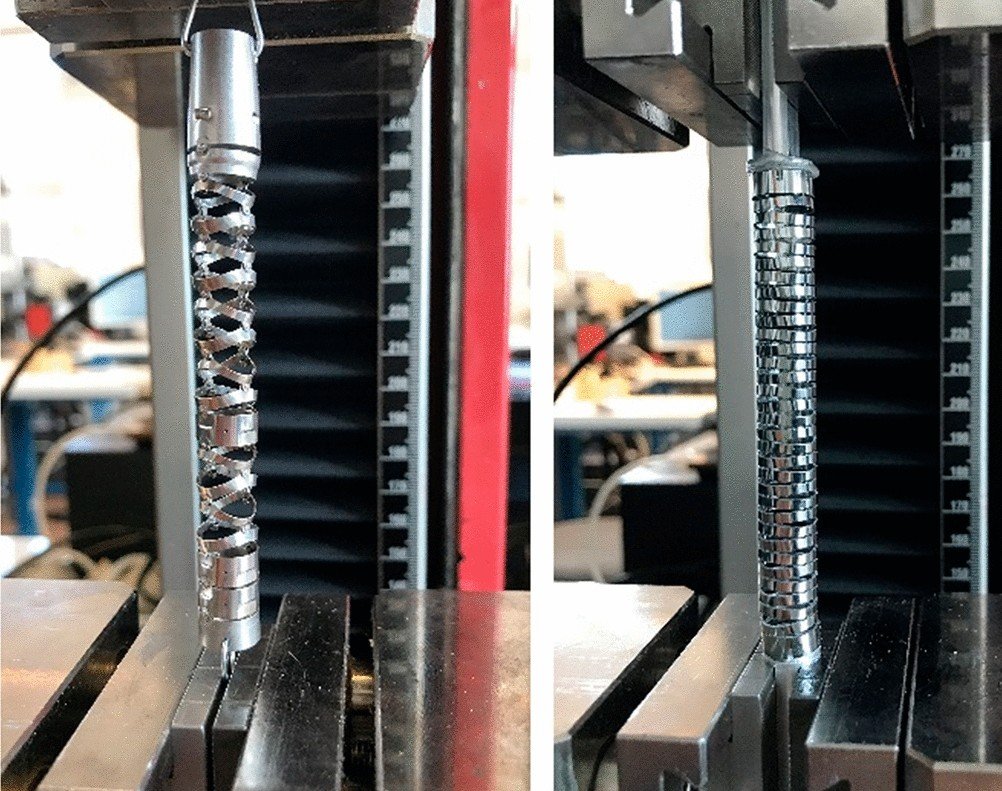
Machined or riveted links (the conventional build). The 2024 Scientific Reports paper by Uhlig and colleagues describes the state-of-the-art construction used in current endoscopes in the 10 mm outer-diameter class: joints made from several cylindrical segments connected by rivets or cylindrically shaped lugs to form sliding hinge joints, often in biocompatible stainless steel. The individual joints are alternately rotated 90° around the central axis so the framework can bend in all directions. Guides for the Bowden cables (pull wires) are integrated into the joint. Working channels, data and supply lines run through the inside; a wire mesh typically supports the joint from the outside.
The 2009 Olympus application (US 2009/0253963 A1; later abandoned) describes the same family of design: a bending tube of substantially cylindrical bending parts, coaxially connected and rotatable with respect to each other; a braid tube covering the outer periphery; and an outer tube of resin. The application’s manufacturing method concerns how a thermoplastic-resin braid is fixed to the end bending parts—useful context for anyone writing a component specification, because the metal links, the braid and the outer covering are a system, not three unrelated catalog items.
The 2024 paper also lists the practical drawbacks of the riveted approach: a large number of individual parts, assembly effort and cost, mechanical axial and rotational backlash, and no inherent defined zero (straight) position.
Laser-cut monolithic tubes. The same paper develops an alternative: a monolithic bending section cut from a superelastic Nitinol tube with a femtosecond laser, then electropolished, for single-use laparoscopic devices (10 mm outer diameter, 64 mm compliant length, 100° bending angle in the study). In that comparison, the laser-cut design reduced actuation force by about 50% and increased the available inner diameter by about 10%, while avoiding link assembly. It also showed a defined center position and no axial play or friction from riveted joints. The riveted stainless-steel reference in the same tensile test failed at a higher load (178 N versus 66 N). The authors note that the relatively high strains in the flexure hinges are suitable only for low cycle numbers; they fully deflected the joint 10 times without damage in their tests, but they did not perform fatigue testing. That caveat matters for reusable GI and pulmonary scopes, which are designed to survive many angulation and reprocessing cycles.
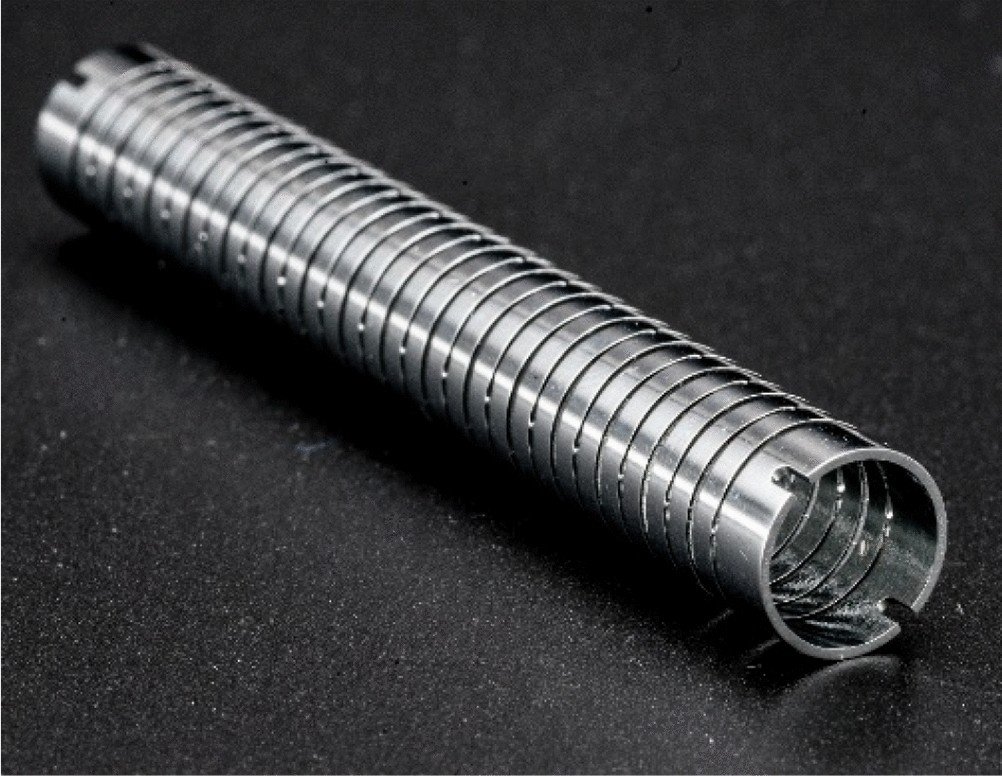
What to put in a bending-section RFQ (questions, not invented answers):
- Link construction: riveted or lug-jointed machined rings, or a laser-cut (or otherwise monolithic) tube?
- Material and covering: metal alloy, mesh or braid, and outer bending rubber or sheath, including how the braid is terminated at both ends.
- Degrees of freedom, target angulation, and whether a defined straight position is required.
- Inner lumen needed for channels, wiring and pull wires.
- Intended use: reusable (cycle life and reprocessing) versus single-use (cost, assembly steps, fatigue may be less critical).
- Tests: angulation, pull-wire friction or force, leak integrity after covering, and dimensional inspection.
Do not treat a supplier’s ability to laser-cut Nitinol for a disposable articulating tip as proof that it can deliver a reusable GI bending section, or the reverse.
Insertion Tubes and Materials
The insertion tube is the long flexible shaft that has to pass through a tortuous anatomy, transmit push and twist from the handle, and protect everything inside it. Olympus’s technology page on in-house production is blunt about why this component is hard: gastrointestinal insertion tubes must traverse long, twisting lumina; makers are pushed to make tubes thinner to reduce patient stress, while still meeting physicians’ demands for bending, twisting, pushing and pulling. When Olympus entered endoscope manufacturing, many of these parts were simply not available on the market, so it developed them itself—including tip parts, image-guide and light-guide fiber, the bending section, bending rubber, and the flexible connecting tube.
Two public sources describe how stiffness is actually built into a tube.
A pending patent application (US 2025/0176807 A1, Adaptivendo LLC) summarizes a typical insertion-tube build: a hand-assembled composite of a coil, a braid, and one or more outer extrusions in different-durometer polymers, reflowed so the jacket bonds the structure together. An alternative is to feed a braided coil through an extruder with more than one resin head. The stated purpose of varying stiffness along the length is clinical: for example, added stiffness in specific sections can help prevent looping in the gastric cavity, and a stiffness profile can help a colonoscope follow the colon without unwanted trauma. The application itself is directed at single-use shaft assemblies and a lower-cost continuous manufacturing method; the coil–braid–sheath description is the conventional baseline it starts from, and it is useful for reusable-tube specifications as well. This article does not treat the application as an issued patent, and it does not attribute the filing to Olympus.
Olympus’s own technology page describes two insertion-tube developments on the reusable-GI side: in the early 1990s, a “continuous connecting tube with continuous flexibility”; and around 2007, a “high force transmission connecting tube” intended to transmit handle operations more smoothly to the tip. The same page says plastic extrusion molding was one of the first processes brought in-house because it is important for ease of insertion. Those statements support a practical sourcing point: if your design needs a continuous stiffness gradient or high force transmission, ask the supplier to show the extrusion or reflow process and how stiffness is measured along the length—not only a finished-tube photograph.
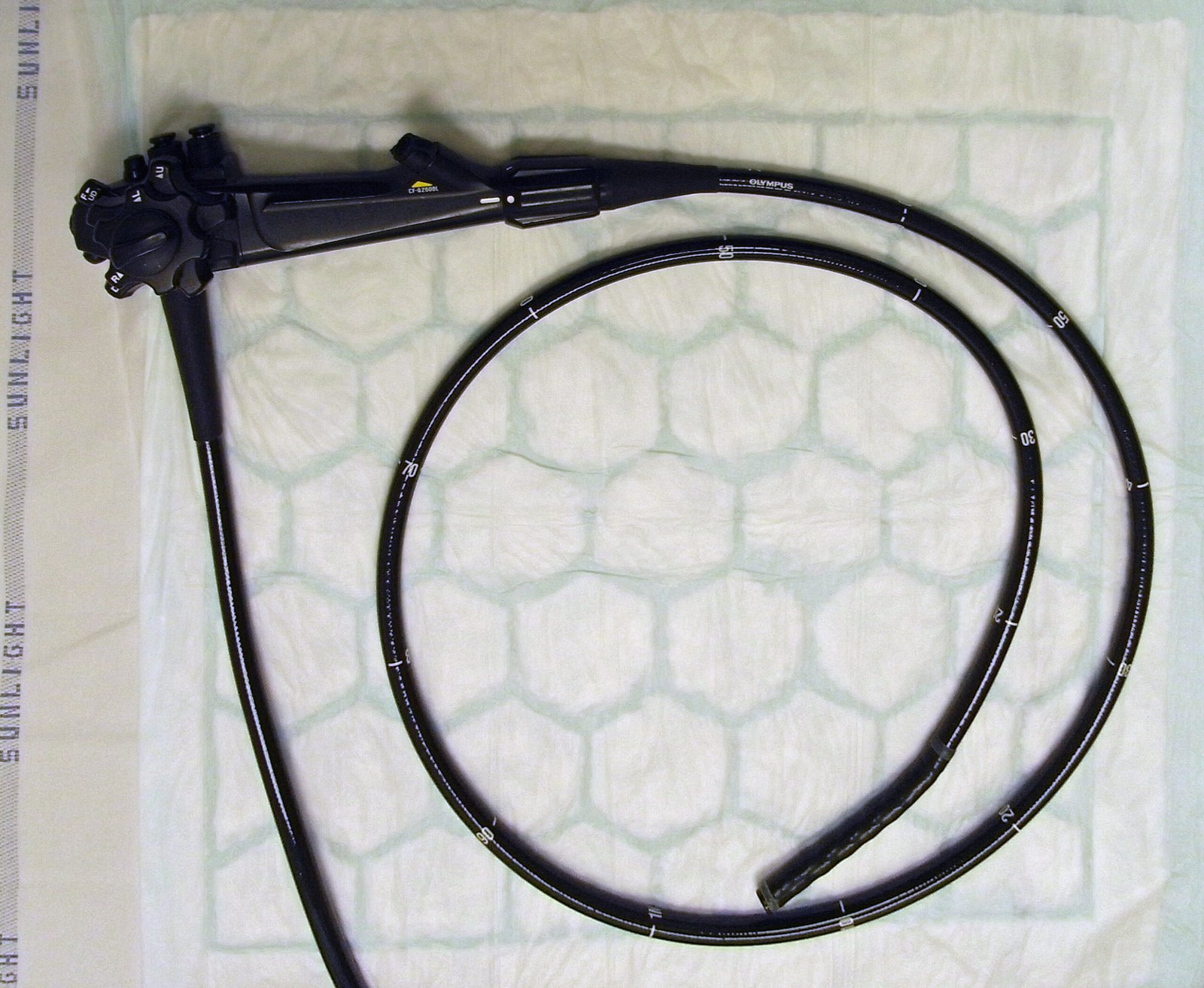
What to put in an insertion-tube RFQ:
- Outer diameter, working length and the location of any stiffness transitions (your design inputs—do not ask the supplier to invent them).
- Construction: coil type, braid material and pattern, outer sheath polymer, and whether stiffness is graded by durometer, geometry, a stiffening element, or a combination.
- Channel and wiring layout inside the tube, and how the tube is joined to the bending section and the control section.
- Tests: bending and torsion behavior, buckling or looping tendency as you define it, leak tightness, and surface/chemical resistance relevant to reprocessing if the scope is reusable.
- Who owns the process parameters (extrusion tooling, reflow recipe) if you later transfer or dual-source the tube.
This article does not publish tolerances, lead times or minimum order quantities. Those figures should come from your drawing pack and from a quoted process, not from a blog post.
Optics, Sensors and Distal Tips
The distal tip is where optical, mechanical and fluid functions meet in a very small housing. A typical video-endoscope tip carries an objective lens, one or more illumination ports (light-guide exits or LEDs), an instrument-channel outlet, and an air/water nozzle used to insufflate and to wash the lens. Those features are visible on finished tips; they also have to be specified, toleranced and tested as a module.
Olympus’s technology page notes that a metal part at the tip “has to be made from stainless steel to resist corrosion by highly acidic gastric juices,” and that in the early 1960s there was no ready market for cutting such minute stainless-steel components. The historical point still matters for sourcing: tip shells, nozzle geometry and optical windows are precision parts with material-compatibility constraints, not decorative caps.
The image sensor behind the objective is a separate—but tightly coupled—decision. Sensor architecture (CMOS versus CCD), package size and heat load affect distal-tip diameter, wiring and the video processor. Endowista’s earlier technical article, CMOS vs CCD Sensors in Flexible Endoscopes, covers that trade-off for R&D teams. This sourcing guide does not repeat that comparison; it only flags that a distal-tip supplier and a sensor or module supplier must work to the same optical prescription.
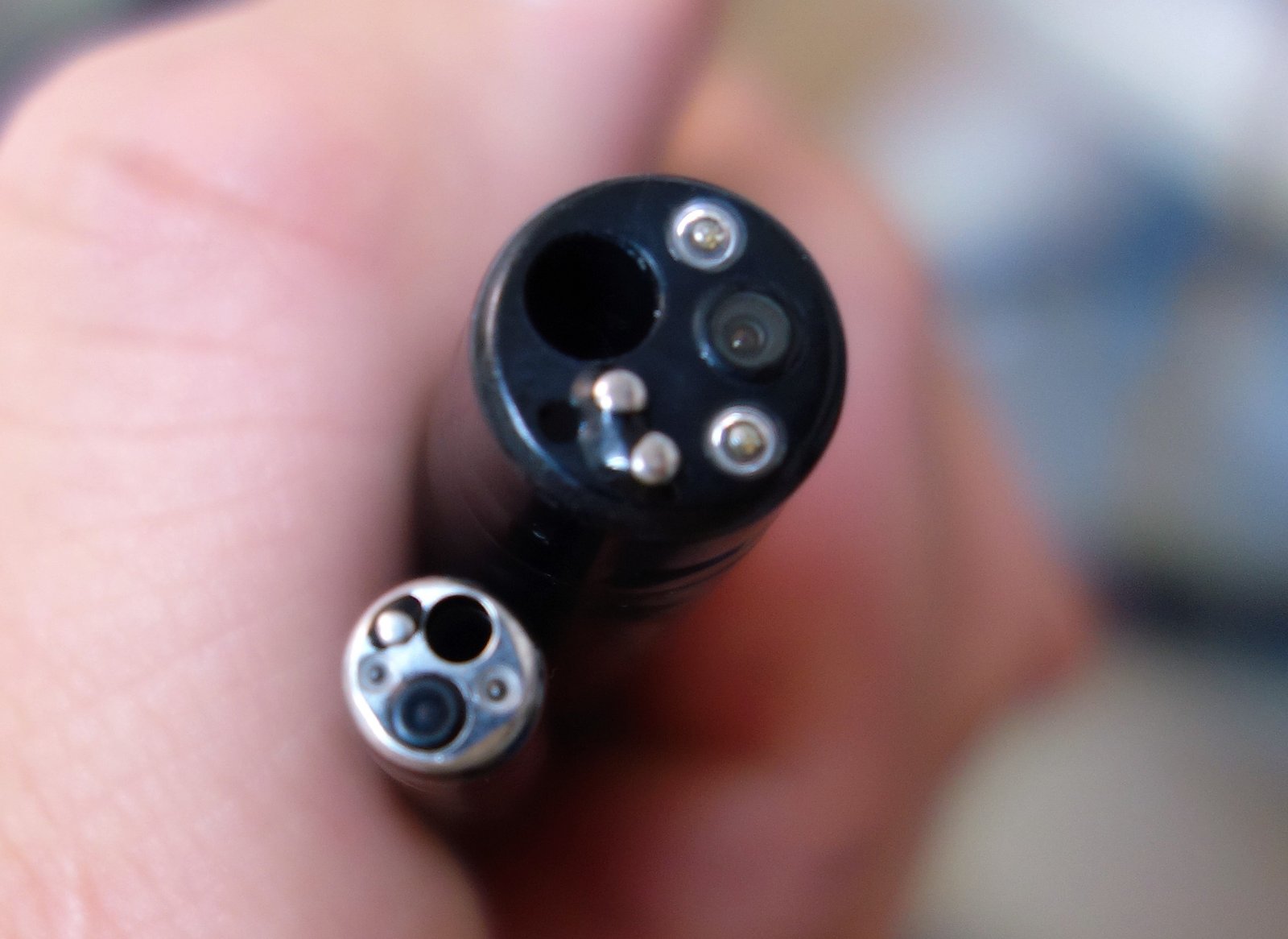
What to put in a distal-tip and optics RFQ:
- Optical targets you already own: field of view, direction of view, depth of field, illumination uniformity, and sensor format (to be verified against ISO 8600-series methods you adopt).
- Mechanical envelope: outer diameter, nozzle aim, channel outlet location, and how the tip attaches to the bending section.
- Materials and biocompatibility strategy for patient-contact surfaces.
- For reusable tips: leak integrity, window abrasion, and chemical resistance under the intended reprocessing method.
- Interface responsibility: who aligns the lens to the sensor, who owns the flex or wiring harness, and how change control works if the sensor is second-sourced.
Supplier Qualification for Components
A components supplier and a finished-scope manufacturer are not interchangeable. FDA’s Quality Management System Regulation (QMSR), effective February 2, 2026, incorporates ISO 13485:2016 by reference into 21 CFR Part 820. FDA states that the QMSR applies to finished device manufacturers who intend to commercially distribute medical devices. ISO 13485 itself is written for organizations in the design, production, installation and servicing of medical devices, and ISO notes that it can also benefit suppliers that provide product or QMS-related services to those organizations.
For an OEM buying bending sections, tubes or tips, the practical implication is: your own QMS still has to control purchasing. The supplier’s certificate is necessary evidence, not a substitute for process and test evidence on your component.
| # | Check | Why it matters | What to ask for |
|---|---|---|---|
| 1 | ISO 13485 certificate and scope | A certificate that covers unrelated devices or a different site does not prove endoscope-component capability. | Certificate, scope statement, sites, last audit date |
| 2 | Process technology that matches the part | Link machining, laser cutting, polymer extrusion/reflow and optical assembly are different processes. | Process flow, equipment list, and a sample or sectioned part of the same construction family |
| 3 | Materials and biocompatibility | Patient-contact polymers and metals need documented evaluation (commonly the ISO 10993 series) and supplier controls. | Material specifications, change-notification rules, biocompatibility strategy |
| 4 | Test methods | Optical, dimensional, leak and angulation results are only comparable if the method is defined. | Test matrix and how it relates to the ISO 8600 series you are using, including ISO 8600-1:2025 |
| 5 | Traceability and change control | Insertion tubes and bending sections fail programs when an undocumented resin, braid or heat-treat change lands in a production lot. | Lot traceability, ECO process, how you will be notified |
| 6 | Component versus finished-assembly capability | A parts shop is not automatically able to deliver a leak-tested insertion portion or a finished reusable scope. | Clear statement of what is in-house versus subcontracted; examples of each |
| 7 | Capacity and documentation support | The legal manufacturer still owns the regulatory file, but the supplier must produce records the file needs. | Typical capacity evidence, documentation list, and any registration-support experience—without treating “we will obtain your 510(k)” as a deliverable |
Red flags in component quotes:
- Price and lead time only, with no test matrix and no process flow.
- “We can make any endoscope part” with no sectioned samples or inspection data for this construction.
- An ISO 13485 certificate whose scope does not include the process or the site that will actually build your part.
- No written change-control commitment on resins, metals, braid, adhesives or optical components.
- Confusion between reusable and single-use requirements (reprocessing and cycle life versus sterile packaging and unit cost).
If the project may later move from components into a finished reusable endoscope, use the CDMO checklist in How to Choose a Flexible Endoscope CDMO in 2026 as well. Endowista also lists consultancy services for production-line and registration questions.
Where Endowista Fits
Endowista is a flexible endoscope OEM and CDMO partner, not a hospital-brand manufacturer. It works with an ISO 13485-certified partner manufacturing facility that has specialized in endoscope manufacturing and OEM/CDMO services since 2010. The partner facility has more than 10,000 m² of production space with independent GMP clean workshops, and two R&D centers in Hangzhou and Shenzhen staffed by 40+ engineers. The partner facility’s public capability descriptions include CNC, laser cutting and polymer processing for endoscopic components.
Through this partnership, Endowista focuses on reusable flexible endoscope programs and related components—not complete single-use endoscope manufacturing. Services include:
- Endoscope components such as insertion tubes, bending sections, light guides and operation sections
- Flexible endoscope CDMO for gastroscopes, colonoscopes, bronchoscopes and sigmoidoscopes
- Production-line and registration consulting
Endowista’s operations center is in Suzhou Industrial Park (SIP), Suzhou, Jiangsu, China, and it has a sales office in Hong Kong.
If your project is a complete single-use scope, shortlist manufacturers that demonstrate sterile single-use production. Endowista can still be relevant for reusable companion products or for component families that are shared in principle (bending sections, tubes, tips)—but it should not be listed as a single-use finished-scope CDMO.
Learn more about Endowista or request a quote for a reusable component or OEM/CDMO project. An overview of end-to-end manufacturing solutions is also available.
FAQ
Which flexible endoscope components do OEMs usually source first?
The parts that most often sit on a critical path are the bending section, the insertion tube, the distal tip (including optics and the instrument-channel outlet), the light guide, and the operation section. Channels, pull wires, braid and outer sheaths are usually specified together with those assemblies rather than as afterthought catalog items.
What is the difference between a machined-link bending section and a laser-cut tube?
A conventional bending section is built from cylindrical links that are riveted or otherwise joined so they can articulate, then covered with a mesh or braid and an outer tube. A laser-cut design forms flexure hinges in a single tube, so there are no individual links to assemble. A 2024 study of a Nitinol laser-cut section for single-use laparoscopic devices reported lower actuation force and a larger inner diameter than a riveted stainless-steel reference, but the authors did not perform fatigue testing and noted that the hinge strains were suitable only for low cycle numbers.
How is insertion-tube stiffness usually controlled?
Public descriptions of typical construction point to a coil, a braid and an outer polymeric sheath. Stiffness along the length is often varied by using more than one polymer durometer, by changing braid or coil pattern, or by adding a stiffening element. Olympus has also described reusable-GI tubes designed for continuous flexibility and for high force transmission. The exact profile belongs in your design inputs and should be verified by measurement, not assumed from a photograph.
Is an ISO 13485 certificate enough to qualify a component supplier?
No. The certificate and its scope are a starting point. You still need process evidence for the specific construction, material controls, a defined test matrix, traceability and change control. In the United States, FDA’s QMSR (effective 2 February 2026) incorporates ISO 13485:2016 into 21 CFR Part 820 for finished device manufacturers; buying components does not remove the legal manufacturer’s purchasing-control obligations.
Does Endowista supply components as well as finished reusable scopes?
Yes. Endowista’s published component offering includes insertion tubes, bending sections, light guides and operation sections, alongside reusable flexible endoscope OEM/CDMO programs. It does not manufacture complete single-use endoscopes. Confirm in the statement of work which steps are components only and which, if any, are finished reusable assemblies.
Sources
- Uhlig, K. et al. — Design, simulation and experimental analysis of a monolithic bending section for enhanced maneuverability of single use laparoscopic devices, Scientific Reports 14, 2024: https://www.nature.com/articles/s41598-024-53914-3 (open access, CC BY 4.0)
- Olympus Corp. — Bending portion of medical insertion apparatus, and manufacturing method and manufacturing apparatus thereof, US patent application US 2009/0253963 A1 (published 8 October 2009; abandoned): https://patents.google.com/patent/US20090253963A1/en
- Adaptivendo LLC — Endoscope insertion tube with graded static stiffness, US patent application US 2025/0176807 A1 (pending): https://patents.google.com/patent/US20250176807A1/en
- ISO — ISO 8600-1:2025 Endoscopes — Medical endoscopes and endotherapy devices — Part 1: General requirements (5th edition, published March 2025): https://www.iso.org/standard/84216.html
- Olympus — Developing Technology for In-House Production: https://www.olympus-global.com/technology/way/challenge/development.html
- ISO — ISO 13485:2016 Medical devices — Quality management systems — Requirements for regulatory purposes: https://www.iso.org/standard/59752.html
- FDA — Quality Management System Regulation (QMSR) (effective 2 February 2026; incorporates ISO 13485:2016): https://www.fda.gov/medical-devices/postmarket-requirements-devices/quality-management-system-regulation-qmsr
- Endowista — Endoscope Components Solutions: https://endowista.com/end-to-end-flexible-endoscope-manufacturing-solutions/endoscope-components-solutions/
- Endowista — Endoscope CDMO Solutions: https://endowista.com/end-to-end-flexible-endoscope-manufacturing-solutions/endoscope-cdmo-solutions/
- Endowista — About: https://endowista.com/your-trusted-flexible-endoscope-manufacturing/
